

Executive Overview
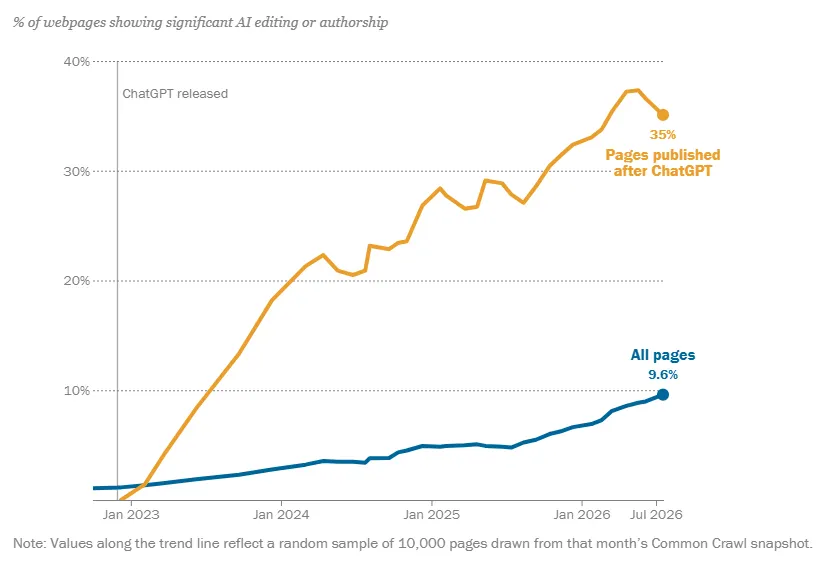
When researchers narrow their scope to content published exclusively after the watershed public launch of OpenAI’s ChatGPT in November 2022, that fraction skyrockets to an astonishing 35%.
This is not merely a statistical anomaly or a temporary tech trend; it represents a fundamental re-architecting of the global information ecosystem. Driven by the explosive growth of content farms, automated publishing tools, and AI-assisted workflows, the internet is steadily filling with machine-generated prose. Yet, this synthetic tide is not rising evenly. A deep dive into the Pew Research data—utilizing the Open Pangram AI detection model across nearly half a million pages from the Common Crawl web archive—reveals stark divides across domain extensions, corporate motives, and institutional publishing standards.
As phrases like "delve," "interplay," and "testament" become ubiquitous linguistic markers of our digital age, policymakers, technologists, and readers alike are forced to confront a pressing existential question: What happens to human trust, institutional integrity, and the future of knowledge when the internet’s primary author is no longer human?
Detailed Chronology: From Pre-GPT Uniformity to the Synthetic Boom
To understand how rapidly the digital world has been transformed, one must look backward to the period just preceding the generative AI boom.

The Pre-ChatGPT Baseline (January 2021 – October 2022)
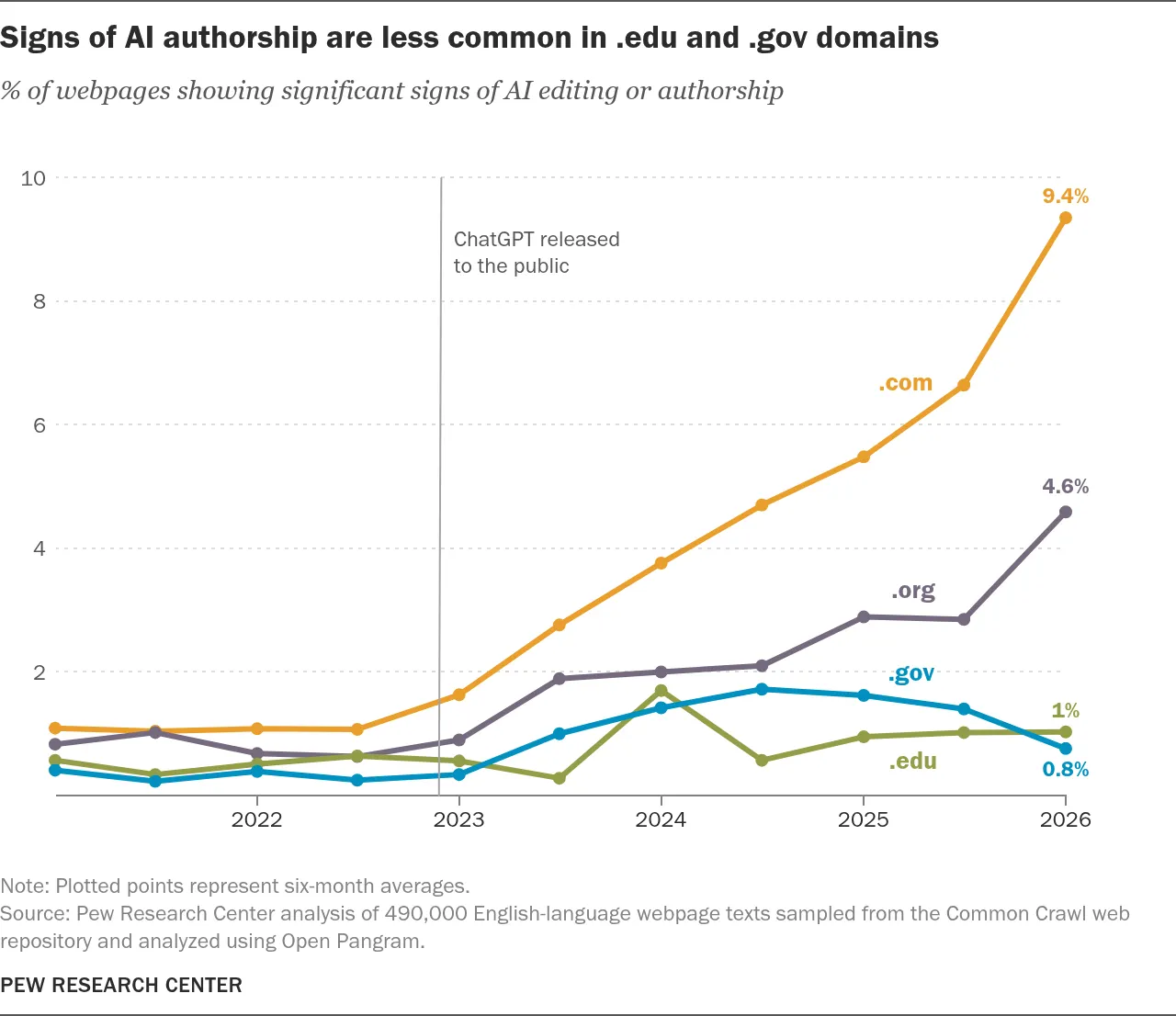
In early 2021, the internet presented a vastly different linguistic profile. When analyzing the Common Crawl archive—a petabyte-scale repository of raw web page data—researchers found that the presence of AI-associated fingerprints across different web sectors was uniformly low. Across .com, .org, .edu, and .gov domains, the incidence of text displaying statistical indicators of machine generation hovered near negligible levels, typically around 1%.
During this era, machine learning models existed primarily in research labs or specialized enterprise environments. Natural language processing tools were largely incapable of producing long-form, coherent, multi-paragraph articles that could seamlessly masquerade as human journalism, corporate copy, or creative writing. Consequently, the statistical distribution of words, punctuation, and structural syntax across all web domains reflected distinctly human stylistic variations.
The Generative Inflection Point (November 2022)
The paradigm shifted permanently in late 2022 with the public release of OpenAI’s ChatGPT. By democratizing access to large language models (LLMs) capable of human-level text generation, the barrier to entry for mass content creation vanished overnight.
Within months of the launch, the digital publishing ecosystem experienced a gold rush. Freelance writers, marketing agencies, search engine optimization (SEO) consultants, and automated content farms began experimenting with generative tools to scale their output exponentially. The consequences were immediate and measurable. As tracking data from the Pew Research Center demonstrates, the rate of AI-influenced text on commercial domains began a steep, uninterrupted ascent.
The Contemporary Reality (January 2021 – July 2026)
Spanning a comprehensive five-and-a-half-year timeline, the Pew study analyzed approximately 490,000 pages pulled from the Common Crawl archive. By July 2026, the cumulative impact of generative AI had transformed the web’s structural composition.
While historical pages published prior to late 2022 continue to dilute the overall internet average—bringing the total aggregate share of AI-flagged pages to roughly 10%—the modern publishing velocity tells a far more radical story. For content born after the dawn of the generative AI era, 35% of all sampled webpages show clear statistical markers of AI generation or significant AI assistance. On .com domains specifically, the AI-authorship rate climbed from roughly 1% in January 2021 to an imposing 9.35% across the entire historical index by January 2026, with post-2022 rates driving the vast majority of that growth.
Supporting Context & Metrics: Unmasking the Machine Fingerprint
Detecting machine-generated content is not a matter of catching a single forbidden word or flagging a specific cliché. Sophisticated detection models, such as Open Pangram developed by Pangram Labs, analyze complex statistical patterns, token probabilities, and syntactical distributions across large batches of text.
The Structural "Tells" of Generative Prose
Despite the adaptability of modern LLMs, they retain distinct stylistic and linguistic habits inherited from their training data. Pew’s findings, which align closely with ongoing tracking by publications like Decrypt and the broader lexicographical consensus (exemplified by Merriam-Webster naming "slop" its word of the year), highlight several key stylistic shifts on the web since 2023:
- Punctuation Spikes: Em dashes—once a stylistic choice heavily dependent on individual author preference—now appear roughly twice as often across sampled web content as they did prior to the AI boom. Similarly, the Oxford comma has seen a 63% increase in frequency.
- Lexical Favoritism: Certain vocabulary words disproportionately favored by popular LLMs have surged in usage. Terms like "delve," "interplay," and "testament" have more than doubled in frequency across the indexed web.
- Negative Parallelism: Syntactical constructions utilizing antithetical phrasing, such as "It’s not just X, it’s Y," have nearly tripled in occurrence since 2023. While still statistically rare overall, their sharp upward trajectory serves as a reliable structural beacon for AI assistance.
The Great Domain Divide
Crucially, the proliferation of AI-generated text is not distributed evenly across the digital landscape. The Pew Research Center’s data reveals a profound structural split determined by domain extensions and publishing intent:
- Commercial Domains (
.com): Sitting at the bleeding edge of the synthetic content wave, commercial domains display signs of AI authorship at rates roughly ten times higher than academic or government sites. Driven by the commercial imperative to churn out high volumes of affiliate-marketing copy, product descriptions, and ad-supported news aggregation,.comsites have eagerly embraced algorithmic drafting. - Organizational Domains (
.org): Non-profit and organizational websites occupy a middle tier, displaying an AI-authorship rate of approximately 4.6%. While these entities often operate with leaner staffs and lean into digital marketing tools, they maintain broader oversight than pure content farms. - Educational and Governmental Domains (
.eduand.gov): Representing the most resilient bastions of human-authored text, both.eduand.govdomains sit stubbornly near a 1% AI-authorship rate. This stark divergence tracks directly with institutional publishing realities: rigorous editorial reviews, multi-layered approval processes, compliance standards, and bureaucratic publishing cycles inherently resist the automated, breakneck publishing speeds enabled by generative AI.
Official Statements and Industry Insights
The rapid encroachment of synthetic text onto the open web has prompted urgent evaluations from researchers, journalists, and technology developers alike.
"Detection models can misclassify individual pages in both directions, and ‘significant signs of AI authorship’ does not mean a page was written entirely by a machine—plenty of the text was likely AI-assisted rather than AI-generated outright."
— Pew Research Center Study Authors
This distinction between AI-generated (fully autonomous machine output) and AI-assisted (human-edited text refined, expanded, or structured by an LLM) is critical for understanding the nuance of the modern internet. Many professional copywriters, journalists, and corporate communicators utilize LLMs as brainstorming partners or drafting assistants, blending algorithmic efficiency with human oversight. However, the sheer scale of the shift points heavily toward unedited mass automation.
Pangram Labs, creator of the Open Pangram model utilized in the study, has seen its detection framework corroborate trends across multiple sectors. Separate research utilizing Pangram’s technology discovered that approximately 9% of U.S. newspaper articles published this year contained significant markers of AI generation—a finding that notably included opinion and editorial pages at prestigious legacy outlets such as The New York Times.
The blurring lines between human and machine journalism have intensified debates over editorial transparency, reader trust, and the integrity of the public record. When major journalistic institutions begin incorporating unflagged or under-disclosed synthetic text into their reporting and commentary workflows, the baseline trust contract between publisher and reader is tested.
Future Outlook: Watermarks, Regulation, and the Fate of the Open Web
As the volume of synthetic text scales toward a projected majority of digital content in the coming decade, the mechanisms used to identify, regulate, and navigate the internet are evolving rapidly.
The Shift Toward Model-Level Watermarking
Relying solely on retrospective statistical text detectors—which look for em dashes, favored vocabulary, and syntactical patterns—is an uphill battle. As large language models become more sophisticated, their outputs naturally mimic human stylistic variance more closely, reducing the reliability of heuristic detectors.
Consequently, the tech industry is shifting its focus upstream. Major AI developers, including Anthropic, are actively developing and implementing model-level text watermarking protocols. By embedding subtle, mathematically verifiable cryptographic or statistical signatures directly into the token generation stream of models like Claude, developers aim to make machine-authored text instantly and definitively recognizable at the point of creation, all while minimizing false positives. If widely adopted across the industry, watermarking could restore a transparent ledger of authorship to digital publishing.
The Economics of Content: Slop vs. Signal
The economic drivers of the internet are also shifting in response to synthetic saturation. As programmatic search engines and social media feeds are increasingly flooded with low-quality, AI-generated "slop," consumers and platforms are placing a premium on verified human authenticity.
For .edu and .gov domains, their low AI-authorship rates may soon transform from a byproduct of bureaucracy into a competitive advantage of trust. Similarly, independent creators, niche newsletters, and premium publishers are increasingly leaning into "proof-of-human" credentials, raw experiential journalism, and unpolished primary reporting to stand out in an ocean of algorithmic homogeneity.
Conclusion
The Pew Research Center’s findings serve as an administrative snapshot of a historic transition. The open web is no longer an exclusively human-curated commons; it is a hybrid ecosystem where algorithms shape a substantial and growing share of the written word. Whether this transformation leads to an era of hyper-efficient knowledge democratization or a descent into a labyrinth of unverified synthetic noise will depend entirely on how developers, publishers, and readers demand transparency in the years to come.