

Executive Overview
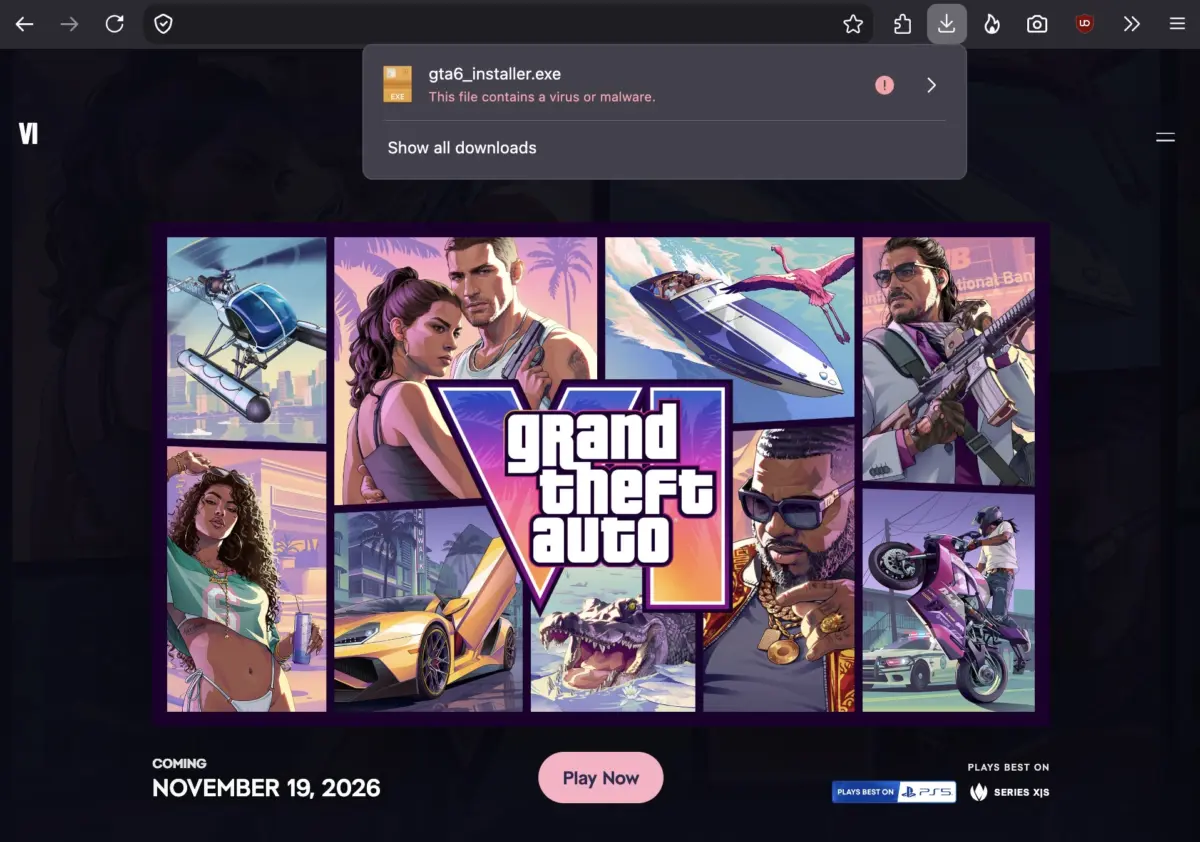
However, this unprecedented level of anticipation has created a fertile landscape for cybercrime. According to recent threat intelligence reports from cybersecurity firm Malwarebytes, threat actors are deploying malicious campaigns utilizing fake websites impersonating Rockstar Games. These fraudulent portals falsely advertise a playable Grand Theft Auto VI demo or an "extended first look," a particularly potent lure given that no official, publicly playable demo of the game exists.
When unsuspecting users fall for these traps and click on the "Play Now" or download buttons, they inadvertently execute an information-stealing malware strain. Disguised as a legitimate game installer, this malicious payload systematically harvests sensitive personal data stored within web browsers, including saved passwords, session cookies, and active login tokens. Crucially, these infostealers are engineered to bypass standard multi-factor authentication (MFA) protocols by hijacking active sessions, giving attackers full access to victims’ digital identities.
With the official release date of Grand Theft Auto VI currently slated for November 19, 2026—following a series of frustrating delays—the window of opportunity for cybercriminals remains wide open. Cybersecurity experts warn that as promotional hype builds, including upcoming media showcases like Netflix’s scheduled extended look, users must exercise extreme vigilance to avoid falling victim to these opportunistic campaigns.
Detailed Chronology: The Evolution of the GTA VI Threat Landscape
The intersection of high-profile entertainment and malicious cyber activity is rarely a coincidence; rather, it follows a meticulously timed playbook that tracks with developer announcements, marketing drops, and community sentiment.
The Decade-Long Wait and the Cultivation of Vulnerability
The journey toward Grand Theft Auto VI began in earnest following the 2013 release of GTA V. As years stretched into decades without a numbered sequel, the appetite for verified information reached fever pitch. Rockstar Games’ notoriously tight-lipped development style left a massive vacuum in the information ecosystem.
In the absence of official updates, rumor mills, speculative leaks, and community-driven hoaxes flourished. Cybercriminals quickly recognized that this vacuum represented a unique social engineering vector. Gamers, conditioned to scour the internet for fragments of news, trailers, or insider builds, became prime targets for deceptive marketing.
The Rise of Phishing and Impersonation Campaigns
By 2024 and 2025, security researchers began documenting an uptick in phishing domains registering variations of Rockstar Games’ branding, trademarks, and anticipated titles. These early campaigns primarily focused on traditional credential harvesting—luring users to fake login portals under the guise of beta sign-ups or early-access registrations.

However, as development progressed and anticipation shifted toward gameplay demonstrations, the sophistication of these attacks evolved. Threat actors moved away from simple credential harvesting forms and toward complex payload delivery mechanisms, embedding malicious executables inside fake installation wrappers that mimic modern high-end PC gaming launchers.
The Malwarebytes Discovery (August 2026)
The threat materialized acutely in August 2026, when cybersecurity analysts at Malwarebytes published a comprehensive threat intelligence briefing detailing a coordinated campaign of fake GTA VI extended look and demo sites.
[User Searches for GTA VI Demo]
       │
       ▼
[Lands on Impersonor Site (Rockstar Fake Portal)]
       │
       ▼
[Clicks "Play Now" / Downloads Installer]
       │
       ▼
[Executes Infostealer Malware]
       │
       ▼
[Harvests Browsers, Cookies, Passwords, & MFA Sessions]
       │
       ▼
[Exfiltrates Data to C2 Server]
According to Malwarebytes, the campaign relies heavily on search engine optimization (SEO) poisoning and social media distribution to push fraudulent domains to the top of search results or gaming forums. Once a user navigates to the rogue site, they are greeted by polished, high-definition graphics lifted directly from official Rockstar marketing materials, establishing a false sense of legitimacy.
The primary vector of infection is a downloadable file disguised as a pre-alpha or demo client. Upon execution, the installer silently drops an information-stealing payload into the victim’s operating system while occasionally displaying a dummy error message to maintain the illusion that the installation simply failed.
Supporting Context & Metrics: The Scale of the Risk
To understand why Grand Theft Auto VI is uniquely positioned as a vector for cybercrime, one must examine the staggering economic and cultural footprint of the franchise, alongside the technical mechanics of modern infostealers.
Franchise Economics and Market Dominance
- Grand Theft Auto V has shipped over 200 million copies worldwide, generating billions of dollars in revenue and sustaining a massive, active player base through GTA Online.
- The cultural impact of the franchise ensures that any news regarding GTA VI trends globally across mainstream media, social platforms, and financial markets (impacting parent company Take-Two Interactive’s stock).
- When Rockstar released the first official trailer for GTA VI in late 2023, it shattered YouTube records, accumulating over 90 million views in its first 24 hours. This massive audience guarantees that a fractional percentage of naive or desperate users falling for a phishing scam still translates to tens of thousands of potential victims.
Anatomy of Modern Infostealers
The malware deployed in these GTA VI campaigns is indicative of a broader shift in the cybercriminal underground toward automated data theft. Unlike ransomware, which announces its presence by locking a system and demanding payment, infostealers operate in total stealth.
These payloads are designed to target:
- Web Browser Databases: Extracting auto-fill data, stored credit card numbers, and plaintext or weakly encrypted passwords from Google Chrome, Mozilla Firefox, Microsoft Edge, and Opera.
- Session Cookies: Hijacking active authentication cookies. This is a critical capability; by stealing valid session cookies, hackers can log into a victim’s cloud accounts, social media profiles, or financial portals as the verified user, completely bypassing multi-factor authentication (MFA) prompts because the system believes the user is already authenticated.
- Cryptocurrency Wallets: Scanning local directories for browser extension wallets (such as MetaMask or Phantom) and desktop wallet files to drain digital assets.
- Discord and Steam Tokens: Stealing gaming and communication platform tokens to pivot into secondary attacks, such as spamming malicious links to friends or liquidating high-value digital inventories.
Official Statements and Industry Response
As cybersecurity firms and entertainment outlets sound the alarm, industry leaders and security advocates are urging caution and reinforcing protocols for digital hygiene.

Rockstar Games and its parent company, Take-Two Interactive, have consistently reiterated that all official communications, trailers, and release schedules are disseminated exclusively through their verified corporate channels, including their official website, verified social media accounts, and major industry showcases. Rockstar has repeatedly confirmed that no public playable demo or pre-release build has been authorized for consumer download.
Security researchers emphasize that game developers almost never distribute playable software demos via direct-download .exe files from independent websites. Instead, legitimate software is distributed through verified digital storefronts such as Steam, the Epic Games Store, PlayStation Network, Xbox Marketplace, or proprietary, authenticated launchers like the Rockstar Games Launcher.
In a statement accompanying their threat advisory, Malwarebytes security analysts noted:
"The desperation for high-profile content creates an environment where basic digital skepticism is abandoned in favor of immediate gratification. Cybercriminals know this human vulnerability well, and they weaponize anticipation with clinical precision."
Furthermore, upcoming promotional windows—such as Netflix’s scheduled broadcast of an extended look at the game—are being flagged by security operations centers (SOCs) as high-risk periods for heightened phishing activity. Industry analysts recommend that platform moderators and search engine providers proactively monitor and de-index fraudulent domains attempting to mimic upcoming media events.
Future Outlook: Navigating the Road to November 2026
As the countdown to November 19, 2026, continues, the cybersecurity landscape surrounding Grand Theft Auto VI is expected to grow increasingly treacherous.
Anticipated Threat Vectors Leading to Launch
- Fake Pre-Order Portals: As the release date approaches, threat actors are expected to pivot from fake demos to fraudulent discount pre-order sites, offering discounted game keys or exclusive in-game bonuses to lure budget-conscious consumers.
- Phishing via Artificial Intelligence: The use of generative AI tools allows scammers to craft highly convincing, error-free phishing emails, support messages, and fake customer service chatbots that impersonate Rockstar representatives assisting with "access issues."
- Malicious Mod and Cheat Ecosystems: Post-launch, the focus will likely shift toward malicious mods, trainers, and multiplayer hacks targeting players seeking unauthorized advantages or custom content.
Best Practices for Gamers and Consumers
To protect personal data, financial assets, and digital identities against infostealer campaigns, security professionals recommend adhering to strict cybersecurity hygiene:
- Verify the Source: Never download software, patches, or demos from unverified third-party websites, forum links, or social media advertisements. Always verify URLs against official corporate domains.
- Rely on Official Storefronts: Legitimate games and demos will only ever be distributed through recognized, trusted platforms with robust security vetting.
- Implement Hardware Security Keys: While software-based MFA (such as SMS or authenticator apps) can occasionally be bypassed by session-stealing cookies, hardware security keys (like FIDO2/WebAuthn-compliant keys) provide stronger resistance against credential and session hijacking.
- Maintain Endpoint Protection: Ensure that reputable antivirus and endpoint detection and response (EDR) software is active, updated, and capable of intercepting known infostealer signatures before execution.
- Monitor Digital Accounts: Regularly review account login activity, connected third-party applications, and financial statements for unauthorized access.
Ultimately, while the wait for Grand Theft Auto VI tests the patience of millions, maintaining a healthy degree of skepticism online remains the single most effective defense against those looking to turn a gaming milestone into a digital catastrophe.