
Executive Overview
Historically, artificial intelligence coding assistants have functioned as isolated, solitary productivity tools. Developers would spin up an agent in their integrated development environment (IDE) or interact with it independently within a private chat window, leaving non-technical stakeholders entirely out of the loop until code was ready for deployment. Slack Code channels shatter this paradigm. By creating a multi-player AI experience, the platform enables teams to direct, review, and sign off on agent-driven code modifications using natural language, all within a governed and secure environment.
Available at no extra cost across all Slack subscription tiers, the initial launch integrates four powerhouse coding agents: Anthropic’s Claude Code, Cognition’s Devin, GitHub Copilot, and Vercel. Industry analysts view the move as a major milestone in Salesforce’s broader strategy to position Slack as the ultimate "home for agents." However, as enterprises rush to capture this first-mover advantage, IT leaders face critical governance, permissioning, and security challenges. This report examines the mechanics of Slack Code channels, industry reactions, security considerations, and the long-term vision of multi-player AI collaboration.
Detailed Chronology: How Slack Code Channels Work
The conceptual and mechanical framework of Slack Code channels was engineered to streamline temporary, project-based development cycles—such as spinning up a new application feature, updating a live web page, or resolving an urgent bug—without forcing participants to switch contexts across multiple specialized platforms.
1. Initiation and Setup
The workflow begins organically in an existing Slack channel or direct message (DM). When a user tags a supported coding agent with a specific request (e.g., "Update the checkout page styling to match our new brand guidelines" or "Fix the null-pointer exception in the user authentication module"), the platform springs into action.
The agent automatically executes three actions:
- Spawns a dedicated, temporary code channel tailored to the project.
- Automatically populates the channel with links to required technical documents, briefs, and context.
- Invites the relevant cross-functional participants based on the nature of the request.
2. The Collaborative Workspace
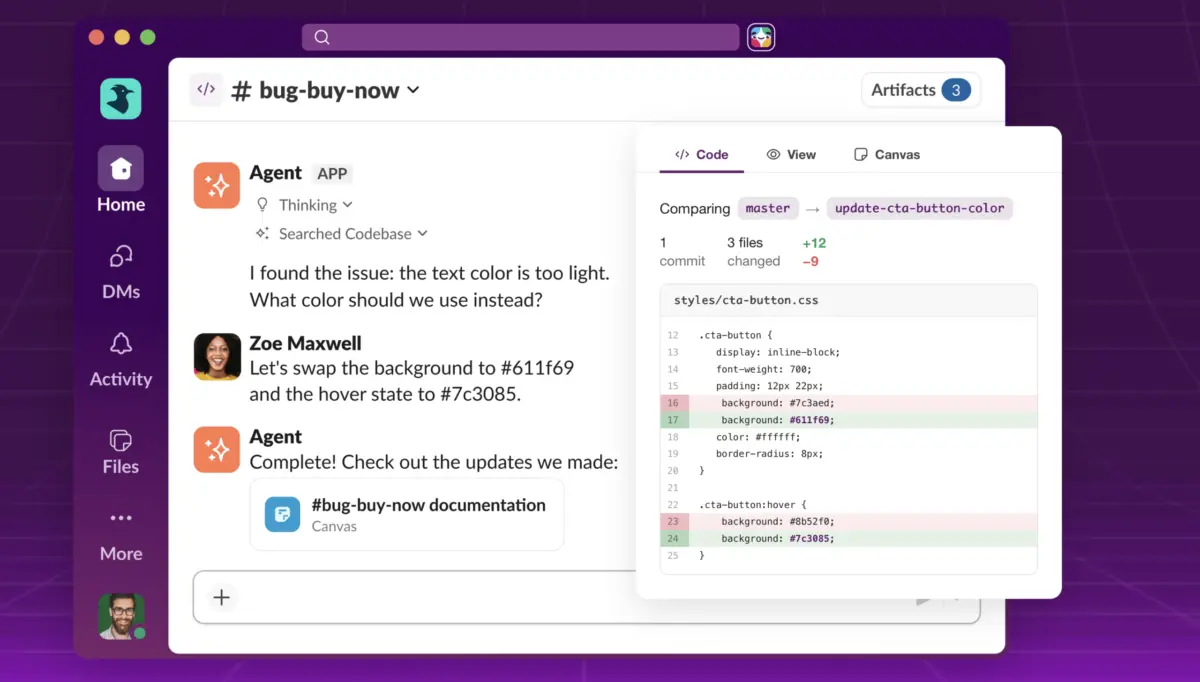
Once inside the code channel, participants experience a familiar interface that behaves much like a standard Slack channel, enhanced with specialized agentic capabilities. Team members can chat, share files, and issue commands using plain, natural language.
Unlike traditional chat rooms, however, these channels feature "session artifacts" designed to maintain absolute transparency over the agent’s work. These artifacts include:
- Code Diffs: Visual, highlighted side-by-side comparisons showing exact code modifications made by the agent in real time.
- Slack Canvas Documents: Dynamic documents outlining project specs, task lists, and architectural notes.
- Live HTML Previews: Interactive prototypes and web page previews generated directly by the agent, allowing product designers and marketers to visually evaluate the output without opening a browser debugger or pulling code from a repository.
3. Review, Sign-Off, and Archival
Throughout the session, non-technical stakeholders can review agent outputs, suggest modifications using everyday language, and approve changes. Crucially, organizational guardrails ensure that code cannot be merged or shipped to production prematurely. Once the task or project reaches successful completion, the code channel is automatically archived, keeping the workspace clean and organized.
Supporting Context & Metrics: The Shift Toward Multi-Player AI
The introduction of Slack Code channels arrives at a critical inflection point in enterprise software tooling. For years, software coordination has relied heavily on Slack as a communication backbone. However, actual code creation remained strictly isolated to developer-centric environments like GitHub, Jira, and local IDEs.
According to Will McKeon-White, senior analyst at Forrester, Slack’s new features make it vastly easier to "just stay in Slack only and [open] up who is involved with the actual code creation." This democratization of software development aligns with broader macroeconomic pressures demanding higher cross-functional efficiency and faster time-to-market.
Wayne Kurtzman, research vice president at IDC, emphasizes that Slack Code effectively "closes the gap between where work gets done and where code gets written with dedicated spaces built for output along project-based channels right in Slack." This reinforces Salesforce’s overarching vision: unifying disparate business applications into a single, cohesive, multi-player environment.
Furthermore, the release is accompanied by structural enhancements designed to manage agent interactions at scale, including:
- Agent DMs: Allowing private, individual consultations with coding agents for sensitive tasks.
- The Agents Tab: A centralized dashboard where users can monitor and review active and past agent conversations across their workspace.
Official Statements and Industry Perspectives
Leadership at Slack and Salesforce have framed the launch not merely as a feature update, but as a fundamental reimagining of human-AI collaboration.
"We built code channels to be this multi-player AI experience and bring more development into Slack," noted Sateja Parulekar, vice president of product marketing at Slack. "It’s not just engineers and product managers who are working with the coding agents; it’s the marketers, the product designers who are now able to interact with a coding agent in a safe, governed environment."
Parulekar stressed that Slack Code channels adhere strictly to the platform’s existing security and enterprise-grade permissions architecture. Workspace administrators retain full control over data access, ensuring that agents can only read and write conversations permitted by established organizational policies. Furthermore, IT admins can institute customized guardrails—such as mandatory engineering reviews—preventing non-technical staff from accidentally deploying unvetted code to production environments.
However, industry analysts advise caution alongside optimism. McKeon-White points out that for IT administrators enabling Slack Code, permissions management remains an immediate and persistent hurdle:
"…Some inherit user permissions based on task, some have persistent permissions with different ‘invoking’ permissions for users, some inherit the permissions of the room. Each has flaws."
Beyond immediate permissioning hurdles, McKeon-White highlights that the longer-term enterprise challenge lies in multi-agent collaboration:
"Multi-agent collab today in successful environments isn’t very dynamic. Having true dynamic agents cooperating can create extremely interesting emergent behavior."
He points to advanced research from organizations like Anthropic, which are actively exploring how autonomous systems coordinate complex workflows without human bottlenecks.
Future Outlook: Beyond Code to Universal Enterprise Workflows
While the initial rollout of Slack Code channels is heavily centered on software engineering tasks—such as bug fixing, prototyping, and feature development—Slack’s long-term roadmap extends far beyond traditional programming.
Salesforce envisions applying this exact same cross-functional, multi-player AI framework to a wide variety of business-critical domains, including marketing campaign creation, legal contract reviews, and financial modeling.
Parulekar illustrated this future trajectory by drawing parallels to non-technical document management:
"That might not involve code per se, but it does involve a very detailed review of a document and tracking changes and a preview of what’s going to be sent out to the customer. In the future, we see this extending to a lot of different teams and use cases for technical and non-technical users."
This strategy builds directly upon recent architectural rollouts, such as the introduction of Claude Tag, an initiative designed by Anthropic to transition workplace AI from a solitary personal assistant into an active, collaborative team member.
What This Means for Enterprise IT Strategy
For Chief Information Officers (CIOs) and Chief Technology Officers (CTOs), Slack Code channels represent both a massive opportunity and an operational governance test. Organizations that successfully adopt these tools stand to dramatically accelerate project velocity, foster radical transparency between technical and business units, and minimize communication friction.
However, realizing these benefits requires proactive planning. IT and security teams must immediately audit their workspace permission structures, establish clear governance guardrails for non-technical code deployment, and train cross-functional teams on effective natural-language prompt engineering and output review.
As artificial intelligence agents rapidly evolve from simple chat-based utilities into proactive, collaborative teammates, environments like Slack Code channels are poised to become the standard operational theater where human creativity and machine intelligence converge.