

Executive Overview
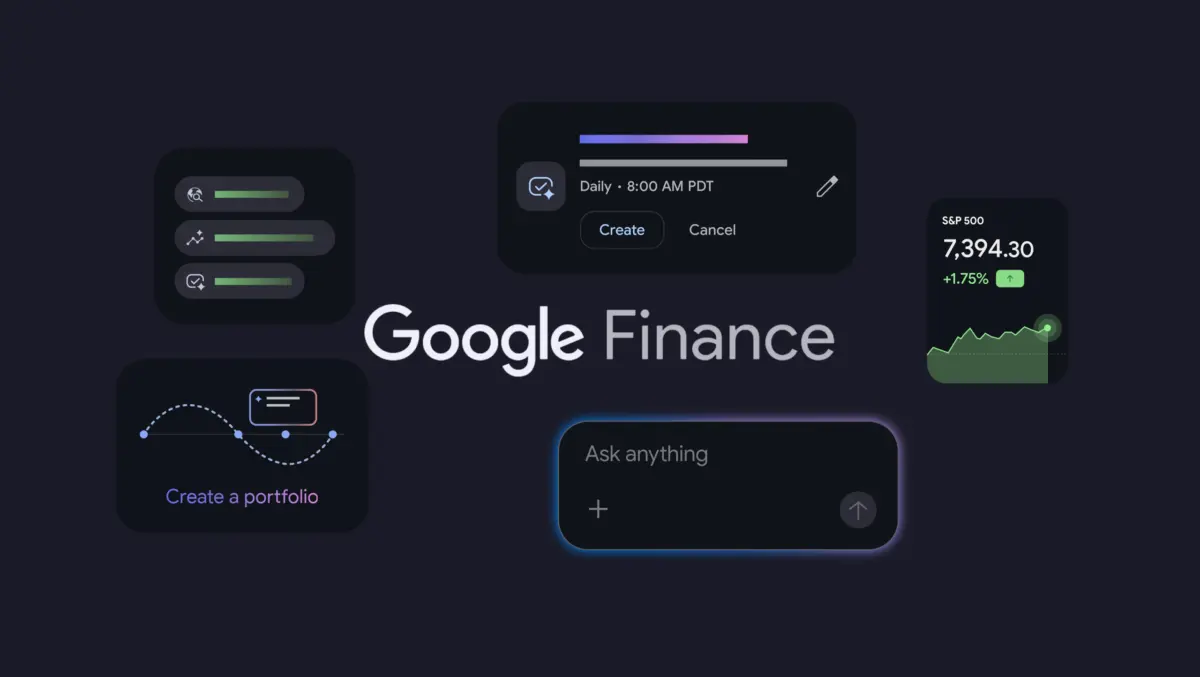
The new application is not merely a mobile mirror of Google’s legacy web tool. Instead, it serves as a vehicle for the company’s advanced generative AI ecosystem. Key features include "Key Moments"—an AI-driven engine that synthesizes news and market data to explain the "why" behind stock movements—alongside real-time market tracking, live financial news feeds, and interactive portfolio dashboards.
Simultaneously, Google announced that its redesigned, AI-augmented Google Finance web experience has officially graduated from its beta testing phase and is rolling out globally. This update introduces conversational portfolio creation, natural-language query tools for asset analysis, and automated, background AI tasks designed to deliver tailored market intelligence.
By launching a dedicated app and embedding sophisticated large language model (LLM) features directly into its finance ecosystem, Google is positioning itself in direct competition with legacy platforms like Yahoo Finance, native utilities like Apple Stocks, and retail trading giants such as Robinhood. This move signals a broader paradigm shift: the transformation of financial search from passive data retrieval to proactive, AI-synthesized financial intelligence.
Detailed Chronology: The Evolution and Rebirth of Google Finance
To understand the significance of this launch, one must look at the turbulent history of Google Finance, which has oscillated between neglect and radical reinvention since its inception.
[2006] Google Finance Launches (Desktop competitor to Yahoo Finance)
  │
  ▼
[2017-2018] Controversial Redesign (Portfolios removed, user backlash)
  │
  ▼
[August 2025] Generative AI Beta (Google tests AI-driven web experience)
  │
  ▼
[June 2026] Global Launch (Dedicated Android App & AI Portfolio Suite Live)
1. The Early Years and Stagnation (2006–2017)
Launched in 2006, Google Finance was designed to challenge the dominance of Yahoo Finance and MSN Money. It featured interactive Adobe Flash charts and integrated Google News results. However, as Google’s corporate priorities shifted toward search, mobile operating systems (Android), and cloud computing, Google Finance languished. A highly controversial redesign in late 2017 and early 2018 stripped away core features—most notably, the ability for users to build and track custom portfolios—sparking widespread backlash from retail investors and driving them to rival platforms.
2. The AI Pivot and Web Beta (August 2025)
Recognizing the explosive growth of retail investing during the post-pandemic era, Google quietly initiated a major overhaul. In August 2025, the company began public testing of a revamped, AI-boosted Google Finance web experience. This beta phase focused on integrating live news feeds and testing early iterations of natural-language processing (NLP) models to help users parse complex financial disclosures.

3. The Standalone Launch (June 2026)
On Thursday, June 11, 2026, Google officially transitioned the web experience out of beta and launched its dedicated Android app. The release represents a structural shift:
- Phase 1 (Immediate): Android app availability in major markets, alongside the global rollout of the updated web experience featuring conversational portfolio management and background AI "Tasks."
- Phase 2 (Upcoming Months): The launch of the iOS application and the introduction of advanced audio integration features, such as the ability to stream and listen to live corporate earnings calls directly within the app.
Deep Dive into the Technology: AI-Driven Portfolios & "Key Moments"
The core differentiator of the new Google Finance app is its reliance on proprietary artificial intelligence models (leveraging Alphabet’s Gemini architecture) to lower the barrier to entry for complex market research. Rather than requiring users to manually cross-reference charts with earnings reports, the platform automates the synthesis of financial data.
Raw Market Data + Global News Feeds
       │
       ▼
[Gemini-Powered AI Engine]
       │
       ├─► "Key Moments" (Explains Stock Volatility)
       ├─► Conversational Portfolio Auditing ("What sectors am I missing?")
       └─► Automated Background Tasks (Delivers tailored market briefings)
"Key Moments": Deconstructing Volatility
The standout feature of both the mobile app and the updated web portal is "Key Moments." When a stock experiences unusual volatility—such as a sudden intraday drop or an after-hours spike—the AI engine crawls financial news, regulatory filings, press releases, and macroeconomic data in real time. It then generates a concise, bulleted summary explaining the catalyst behind the movement (e.g., an earnings miss, a regulatory probe, a supply chain bottleneck, or a competitor’s product launch). This addresses a classic pain point for retail investors, who frequently see a stock price move without immediately understanding the underlying cause.
Conversational Portfolio Creation and Auditing
The global rollout of the portfolio dashboard introduces a highly intuitive interface for tracking personal investments. Users can migrate their existing Google Finance portfolios automatically, or they can build new ones through two novel methods:
- File Uploads: Importing standard financial document formats.
- Conversational Input: Users can describe their holdings to a built-in chatbot in plain English (e.g., "I own 50 shares of Apple bought at $175, 10 shares of NVIDIA bought at $900, and 100 shares of an S&P 500 ETF bought at $450"). The AI automatically parses this text, matches the tickers, records the cost basis, and populates the dashboard.
Once set up, the portfolio acts as a dynamic database. Users can run natural-language queries against their holdings, asking questions like:
- "What sectors are currently underrepresented in my portfolio?"
- "Show me which of my holdings have the highest exposure to European regulatory changes."
- "Summarize the consensus analyst rating for the stocks in my watchlist."
Automated Background Tasks
Google has also introduced an automation layer allowing users to set up recurring analytical tasks using natural-language prompts. For example, a user can instruct the system: "Every Friday afternoon, send me a briefing analyzing how macroeconomic interest rate discussions affected my tech holdings this week." Once established, these tasks run silently in the cloud, utilizing Google’s retrieval-augmented generation (RAG) systems to deliver personalized, highly contextual intelligence reports.
Supporting Context & Metrics: The Battle for the Retail Investor
Google’s decision to build a standalone finance application is a calculated response to structural changes in the retail investing landscape. Since the retail trading boom of 2020, millions of individual investors have entered the market, demanding institutional-grade data packaged inside clean, accessible mobile interfaces.

The Competitive Landscape
| Feature / Platform | Google Finance App (2026) | Yahoo Finance | Apple Stocks | Robinhood / Webull |
|---|---|---|---|---|
| Primary Focus | AI-Driven Market Intelligence | Comprehensive Data & Community | Basic Tracking & Apple News | Brokerage & Active Trading |
| AI Synthesis | Advanced (Gemini integration, natural-language queries) | Moderate (Standard news aggregation) | Minimal (Standard news curation) | Low (Primarily transactional AI tools) |
| Portfolio Setup | Conversational input, file upload, manual | Manual input, brokerage sync | Manual watchlist tracking | Direct brokerage integration |
| Ad Load / Monetization | Low (Ecosystem lock-in focused) | High (Display ads, premium subscriptions) | Low (Ecosystem utility) | High (Payment for Order Flow, interest) |
By positioning itself as a pure information portal rather than a brokerage, Google avoids the complex regulatory scrutiny faced by trading platforms like Robinhood, while offering a significantly more modern, AI-centric user experience than legacy competitors like Yahoo Finance.
Official Statements and Strategic Analysis
The Corporate Narrative
In its official product announcement, Google framed the updates as a natural evolution of its core mission to organize the world’s information and make it universally accessible:
"We are bringing the power of our latest AI models to Google Finance to help people make sense of complex financial information. Whether you’re a seasoned investor or just starting out, these tools are designed to cut through the noise, providing clear, real-time insights tailored to your personal financial journey."
The Investigative Angle: Why Now?
Industry analysts point out that Google’s financial app launch is less about capturing ad revenue from stock charts and more about user data retention and AI training loops.
By capturing highly specific, high-intent user data—such as what stocks individuals own, which sectors they worry about, and what financial questions they ask—Google can significantly refine its advertising targeting profiles. Furthermore, financial queries are among the most lucrative search verticals in the world. Keeping users within a dedicated Google Finance app prevents them from migrating to OpenAI’s ChatGPT, Perplexity, or specialized financial search engines for their market research.
Future Outlook: The Convergence of FinTech and Generative AI
The launch of the Google Finance app on Android and the global rollout of its web-based portfolio tools represent the opening salvos in a broader war for AI-driven consumer finance.
What to Expect Next
- iOS Deployment: The release of the iOS application will be crucial. To compete effectively with Apple Stocks, which enjoys deep native integration within the iOS ecosystem, Google will need to ensure its AI capabilities (such as "Key Moments") are friction-free on rival hardware.
- Multimedia Integration: The upcoming ability to stream live earnings calls and receive real-time AI transcription and summarization could disrupt traditional financial media outlets and specialized corporate access platforms.
- The Monetization Question: While Google Finance is currently free and focused on ecosystem lock-in, the computational cost of running continuous, personalized AI portfolio analyses in the background is high. It remains to be seen if Google will eventually gate premium AI insights behind a subscription model, similar to Google One AI Premium.
Ultimately, Google’s aggressive push into standalone financial software highlights a broader trend: the future of investing is not just about having access to data, but about who has the best AI to interpret it. By turning raw market numbers into conversational, actionable narratives, Google is positioning itself to be the primary lens through which the modern retail investor views the global economy.