

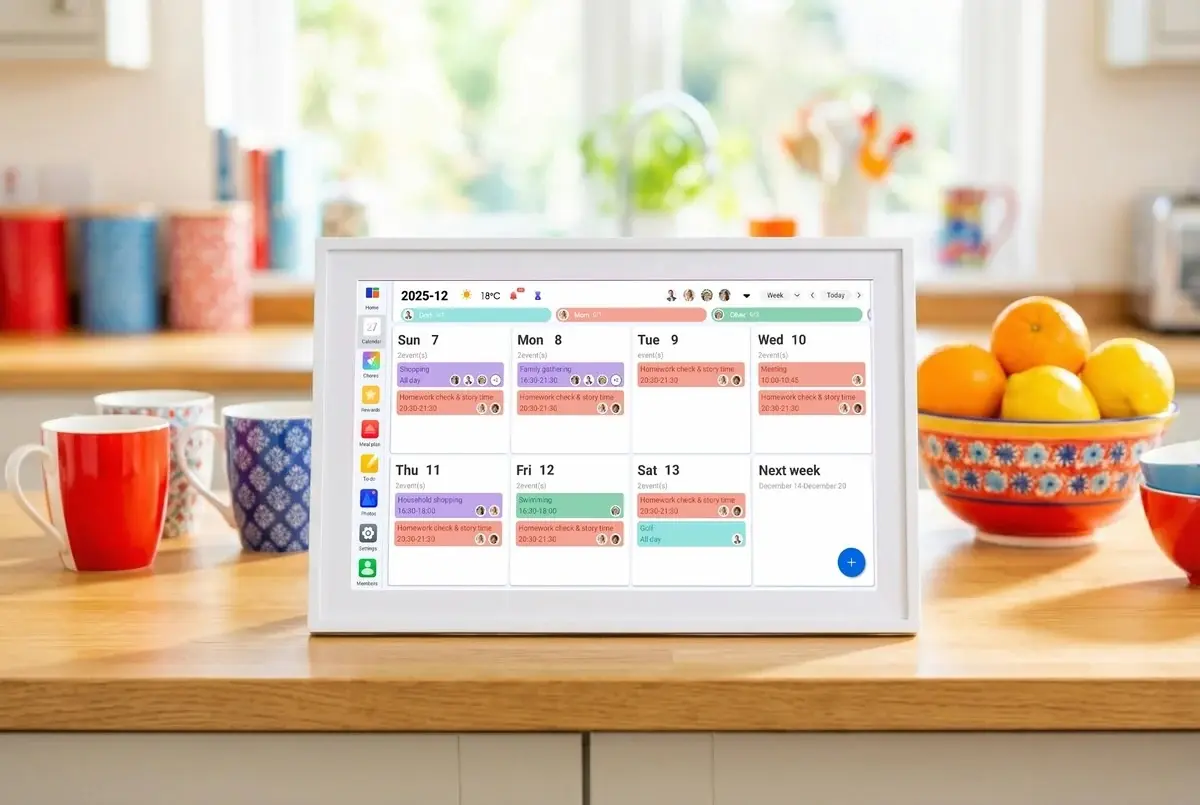
Enter the smart digital family calendar: a specialized touchscreen tablet engineered not for a single individual’s productivity, but designed from the ground up to orchestrate the complex logistics of an entire household. Among the emerging competitors in this high-stakes consumer tech category, Linkdaze has staked a compelling claim. By blending hardware flexibility, multi-platform synchronization, innovative artificial intelligence integrations, and a bold no-subscription pricing model, Linkdaze is challenging established players and offering a fresh perspective on how families, roommates, and busy professionals manage their daily lives.
Executive Overview: A Paradigm Shift in Domestic Organization
The modern household operates with the complexity of a small enterprise. Between remote work schedules, hybrid schooling, athletic practices, chore distribution, and social obligations, the margin for scheduling error is razor-thin. For years, digital organization has been siloed inside individual smartphones and personal apps, leaving families to rely on fragmented communication methods—group text chains, refrigerator whiteboards, and overlapping reminders—that frequently result in missed appointments and domestic friction.
The Linkdaze smart digital calendar, which launched its product line last December, seeks to bridge this gap by serving as a centralized, interactive command center for the home. Mounted to a wall or resting on a kitchen counter, the touchscreen tablet aggregates diverse schedules into a single, highly visible interface.
What separates Linkdaze from standard smart home displays or basic tablets is its hyper-focus on domestic workflow synchronization. Rather than forcing family members to abandon their preferred digital ecosystems, Linkdaze bridges the technological divide, pulling data from disparate calendars and presenting it in an intuitive, color-coded dashboard. Coupled with creative utility features—ranging from chore incentive tracking to AI-driven meal planning—the device represents a broader shift toward ambient, frictionless family management technology.
Detailed Chronology: The Evolution and Feature Set of Linkdaze
From Concept to Countertop: The Product Rollout
Launched in December, the Linkdaze ecosystem was conceived to address the friction points inherent in multi-user scheduling. Recognizing that different households have vastly different spatial constraints and aesthetic preferences, the company rolled out its hardware in two distinct form factors: a compact 10.1-inch model and a sprawling 15.6-inch interactive touchscreen display. This sizing flexibility allows users to tailor the digital canvas to their specific wall space or countertop real estate.
Overcoming Ecosystem Fragmentation
One of the most persistent hurdles in collaborative household planning is ecosystem fragmentation. In many families, one parent may rely heavily on Google Calendar, the other on Apple’s iCloud, while older children manage their academic lives through Outlook or specialized family-organizing applications like Cozi.
Rather than demanding that users migrate to a proprietary, closed ecosystem, Linkdaze was engineered with universal compatibility at its core. The system seamlessly synchronizes across Google, iCloud, Outlook, Yahoo, and Cozi platforms. Once integrated, the device aggregates these disparate data streams into a unified master schedule, utilizing a sophisticated color-coding system to ensure that individual family members remain instantly identifiable at a glance.
Beyond Appointments: Chores, Lists, and Memories
While schedule management serves as the foundational anchor of the device, Linkdaze has expanded its utility far beyond basic time-blocking. The operating software includes dedicated modules for:
- Chore Management & Rewards: Interactive systems designed to gamify household responsibilities for children and teens.
- Dynamic Shopping Lists: Collaborative lists that update in real-time as items are depleted around the house.
- Ambient Display Modes: When not actively managing schedules, the device can double as a digital photo frame, cycling through curated albums of family memories.
The Innovation of "Snap-to-Sync" AI Meal Planning
Perhaps the most notable differentiator in the Linkdaze software suite is its artificial intelligence-driven meal planner, anchored by a feature dubbed "Snap-to-Sync."
Meal planning is traditionally an administrative bottleneck for households, requiring users to manually input recipes, cross-reference dietary restrictions, and build grocery lists item by item. Linkdaze bypasses this friction through visual data capture. Users can simply use a smartphone or the tablet interface to snap a photograph of a physical paper recipe clipped from a magazine, a handwritten family index card, or even a school cafeteria lunch menu sent home by a child’s teacher.
The device’s onboard AI processes the image, extracts the culinary data, automatically integrates the meals into the digital calendar, and synthesizes a corresponding shopping list. While visual-to-text integration is not an entirely novel technological concept in the broader software landscape, applying it directly to domestic meal coordination represents a massive quality-of-life upgrade that elevates Linkdaze above standard digital wall calendars.
Supporting Context & Metrics: Challenging the Subscription Status Quo
To fully understand the market positioning of Linkdaze, one must examine the broader economic landscape of the smart home display category. Over the past several years, hardware manufacturers have increasingly gravitated toward recurring revenue models, baking ongoing software support, advanced cloud storage, and premium features behind mandatory monthly or annual subscription paywalls.
The Subscription Divide
In the smart family calendar sector, competitors such as Skylight have popularized hardware-plus-subscription models. For example, Skylight offers core functionalities out of the box, but unlocks advanced organizational features—such as chore charts, meal planning tools, and enhanced mobile app syncing—through an annual subscription tier priced at approximately $79 per year.

Linkdaze has deliberately charted a different course. By offering its comprehensive suite of scheduling, AI meal planning, chore tracking, and list-making features entirely subscription-free, the company has made a calculated bet on consumer sentiment. In a market fatigued by subscription creep, where consumers face recurring fees for everything from media streaming to cloud storage, the promise of a fully functional device free of ongoing monthly overhead is a powerful marketing hook.
Industry analysts note that this strategy presents a double-edged sword for a hardware startup entering a crowded sector. On one hand, it serves as a massive differentiator, lowering the barrier to entry and appealing directly to cost-conscious consumers. On the other hand, foregoing recurring software revenue places immense pressure on initial hardware sales margins and long-term product lifecycle monetization.
Pricing and Affordability Metrics
This subscription-free ethos extends directly to the retail pricing of the hardware itself. When compared directly to established market leaders, Linkdaze undercuts competitors significantly on upfront costs:
- The 10.1-inch Linkdaze Model: Retails at an MSRP of $119.99, though promotional pricing has seen the entry-level unit discounted heavily on platforms like Amazon.
- Comparative Hardware: Standard 10-inch smart calendar models from competitors like Skylight often feature lower baseline sticker prices for the physical unit, but the true cost of ownership rises when factoring in the mandatory or recommended annual software fees required to unlock the device’s full potential.
By positioning its hardware as an accessible, one-time purchase, Linkdaze is aggressively targeting budget-conscious parents and tech enthusiasts who want high-end organizational capability without the encumbrance of a recurring bill.
Official Statements and Industry Perspective
Industry observers and consumer tech analysts have closely monitored the rollout of subscription-free smart displays, viewing them as a necessary counter-movement against subscription fatigue.
While manufacturers of subscription-backed hardware argue that ongoing fees are necessary to fund continuous software development, cloud infrastructure maintenance, and feature updates, consumer advocates and tech reviewers point out that upfront hardware costs should inherently cover a baseline period of functionality.
By maintaining a feature-complete product without locking core tools behind a paywall, Linkdaze has positioned itself as an ally to the consumer. Reviewers evaluating the device’s performance note that the user interface remains snappy, the multi-platform synchronization behaves reliably across Google and iCloud ecosystems, and the "Snap-to-Sync" AI feature performs remarkably well under real-world kitchen conditions—proving that budget-friendly hardware does not necessarily equate to compromised performance.
Future Outlook: Versatility Beyond the Family Home
While the marketing narrative surrounding smart calendars naturally leans toward suburban families navigating school schedules and sports practices, the structural utility of devices like Linkdaze extends into several adjacent demographic sectors.
The Shared Living Space: College Apartments and Co-Living
Beyond the traditional family home, the Linkdaze calendar finds a natural secondary market in shared collegiate housing and adult co-living spaces. In environments where multiple roommates must coordinate shared grocery budgets, rotating chore responsibilities, study schedules, and guest visits, domestic disputes frequently stem from communication breakdowns. A centralized, touchscreen command center mounted in a common area like the kitchen provides an impartial, highly visible source of truth that minimizes interpersonal friction.
The Professional Desk: Juggling Complex Workflows
Furthermore, independent professionals, freelancers, and remote workers who manage intensive schedules—juggling interview deadlines, client meetings, editorial assignments, and asynchronous communications—can utilize a dedicated secondary display to keep peripheral tasks from bleeding into primary deep-work sessions. By offloading logistical tracking to a physical, dedicated ambient display, users can maintain cognitive clarity on their primary desktop monitors.
What Lies Ahead for Linkdaze
As the smart home category continues to mature, the trajectory of Linkdaze will likely depend on its ability to scale hardware distribution, maintain robust API integrations as major tech ecosystems (Google, Apple, Microsoft) update their security and calendar protocols, and refine its AI capabilities.
If the company can maintain its subscription-free value proposition while continuing to introduce intelligent software enhancements—such as deeper smart home automation integrations or expanded voice assistant compatibility—it stands to permanently alter consumer expectations regarding what a family calendar should cost, both at the register and over its lifetime.
For now, as households brace for the inevitable logistical hurdles of the autumn season, devices like the Linkdaze smart calendar offer a welcome technological antidote to modern chaos, transforming scattered digital information into unified domestic harmony.