

Executive Overview
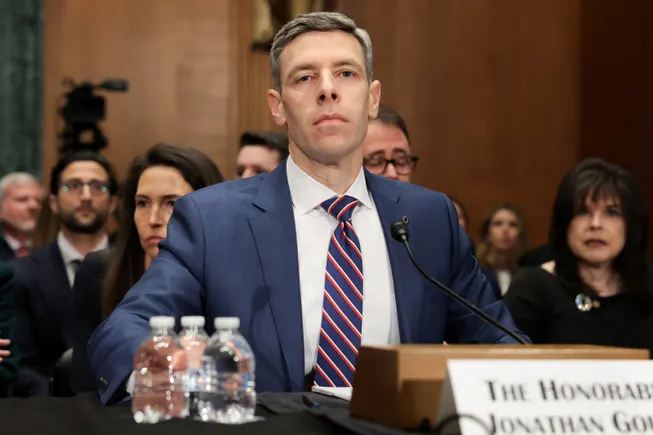
It was fitting, therefore, that the digital-asset sector received arguably its most momentous institutional validation to date during this year’s symposium. Comptroller of the Currency Jonathan Gould took to the stage on Wednesday, delivering a landmark address that signaled a tectonic shift in how federal regulators view the intersection of cryptocurrency and traditional banking. Moving away from the defensive posture of past administrations, Gould’s remarks outlined a future where blockchain technology, payment stablecoins, and decentralized financial architecture are not merely tolerated, but actively woven into the foundational fabric of the U.S. banking system.
Gould’s comprehensive address distilled the current administration’s philosophy into several core revelations: crypto is officially part of the modern banking business; the previous era’s strategy of risk-elimination and regulatory hostility was fundamentally shortsighted; the Office of the Comptroller of the Currency (OCC) exists to ensure system relevance, not to protect legacy incumbents; and internal cultural transformation remains both the greatest challenge and the most vital prerequisite for the agency’s future.
For an industry long accustomed to regulatory ambiguity, hostile enforcement actions, and the chilling effect of "de-banking," Gould’s address marks a decisive turning point—a regulatory green light that promises to reshape the American financial landscape for decades to come.
Detailed Chronology: The Evolution of Federal Oversight
To fully grasp the magnitude of Jonathan Gould’s address at the Wyoming Blockchain Symposium, one must examine the chronological trajectory of the OCC and its shifting relationship with financial technology over the past decade.
The Post-Crisis Caution and the Biden-Era Freeze
In the wake of the 2008 financial crisis, federal banking regulators—including the OCC, the Federal Reserve, and the Federal Deposit Insurance Corporation (FDIC)—adopted an overwhelmingly risk-averse posture. Tasked with ensuring the safety and soundness of the national banking system, these institutions naturally gravitated toward perimeter defense.
However, as cryptocurrency evolved from an obscure cryptographic experiment into a multi-trillion-dollar asset class, this institutional caution calcified into outright hostility during the Biden administration. Between 2021 and 2024, the federal regulatory apparatus deployed what industry participants frequently termed "Operation Choke Point 2.0." Under this unwritten yet palpable policy, banks were heavily discouraged—and in many cases explicitly warned—against servicing digital-asset firms, integrating blockchain infrastructure, or touching anything remotely related to cryptocurrency.
During this period, the OCC operated under a cloud of implicit threats regarding "reputational risk." Even when specific digital-asset activities were entirely permissible under existing law, banks engaging with the sector faced intense regulatory scrutiny, heightened examination standards, and severe reputational penalties. The official stance was one of containment: shield the traditional banking system from crypto at all costs, treating blockchain technology as an inherent hazard rather than a transformative financial tool.
The 2025–2026 Turning Point
The political realignment of recent years triggered an immediate administrative pivot across federal financial agencies. As new leadership took the helm at the OCC, the institutional mandate underwent a radical inversion. Rather than viewing digital assets as a threat to be quarantined, the new administration recognized that ignoring technological innovation posed an existential threat to the long-term relevance of the banking system itself.
This philosophical pivot materialized rapidly in application data. Over the 18 months preceding Gould’s address, the OCC received approximately 40 applications for new national bank charters. Remarkably, 23 of those applications—well over half—explicitly incorporated digital-asset activities into their core business models. This represented an eightfold increase in digital-asset-focused charter applications compared to the entire four-year span of the preceding administration.
The Wyoming Address: A Defining Milestone
Wednesday’s address at the Wyoming Blockchain Symposium served as the formal crystallization of this new regulatory doctrine. By choosing a venue synonymous with state-level crypto innovation, Gould telegraphed that federal regulators and decentralized innovators are no longer adversaries operating across a chasm of mistrust, but collaborative stakeholders building the next generation of financial infrastructure.
The speech not only laid bare the policy failures of the previous administration but also provided a clear, actionable roadmap for how the OCC intends to govern the integration of digital assets through 2026, 2027, and beyond.
Supporting Context & Metrics: The Numbers Behind the Shift
A rigorous analysis of Gould’s remarks requires examining the underlying metrics that illustrate both the rapid normalization of digital assets within the banking sector and the operational pressures facing the OCC itself.
The Charter Application Surge
The most telling metric cited by Comptroller Gould is the profound acceleration in new-bank charter applications featuring digital-asset components.
- The Biden Era (2021–2024): Characterized by negligible interest in digital-asset charters, largely driven by the prevailing regulatory climate of fear and reputational risk warnings. Applications attempting to integrate blockchain technology or stablecoin rails faced systemic administrative roadblocks or indefinite delays.
- The Current Administration (2025–2026): A dramatic reversal. Out of 40 new-bank charter applications submitted over an 18-month window, 57.5% (23 applications) integrated digital assets. This represents an eightfold increase in digital-asset-focused submissions compared to the prior four-year average.
This statistical leap demonstrates that capital and entrepreneurial talent are no longer seeking to bypass the regulated banking system via offshore entities or purely decentralized workarounds. Instead, they are actively pursuing traditional banking charters, eager to operate within a regulated, compliant framework—provided the regulator is willing to meet them halfway.
Stablecoins as "Ordinary Course" Commerce
Gould’s observation that payment stablecoins are rapidly becoming an "ordinary course" component of new business plans is validated by transaction volume and corporate adoption trends. Stablecoins—digital tokens pegged to fiat currencies like the U.S. dollar—have evolved from speculative trading pairs on crypto exchanges into dominant global payment rails.
By integrating payment stablecoins into traditional banking business plans, institutions are seeking to capture the immense efficiencies of 24/7/365 settlement, cross-border payments with near-zero friction, and automated treasury management via smart contracts. The OCC’s willingness to evaluate these business models signals that federal banking supervision is finally adapting to the realities of real-time, globalized digital commerce.
Internal Headcount and Operational Constraints
Beneath the optimistic narrative of regulatory modernization lies a complex operational reality at the OCC. As revealed by internal agency documents reviewed by Politico in June, the OCC has undergone significant structural downsizing.
- Headcount Dynamics: The agency’s current staffing level stands at approximately 2,600 employees—reflecting a reduction of roughly 1,000 personnel compared to 2024 staffing levels.
- The Supervisory Burden: This contraction in workforce creates a formidable challenge. Managing a surge in complex, technology-heavy charter applications while simultaneously designing advanced supervisory frameworks requires specialized expertise.
Gould addressed this tension directly, noting that his primary anxiety is not whether the financial system will modernize, but whether the agency’s internal personnel possess the enthusiasm, technical literacy, and vigor required to execute this massive regulatory pivot with limited resources.
Official Statements: Deconstructing Comptroller Gould’s Address
To fully understand the policy implications of the Comptroller’s speech, we must examine his core pronouncements, sentence by sentence, within the broader context of American financial jurisprudence.
1. On Integration: "Crypto is part of the business of banking."
"It is becoming ordinary course to involve and integrate payment stablecoins, etc., in the business plans that we are now seeing presented to the OCC for consideration."
Analysis: This statement represents a decisive linguistic and conceptual departure from past regulatory guidance. By refusing to place digital assets in a separate, quarantined category, Gould signaled that crypto is no longer viewed as a peripheral asset class or an exotic derivative. When stablecoins and tokenized assets are treated as "ordinary course," they are subjected to standard, risk-managed banking frameworks rather than ideological exclusion. Furthermore, by contrasting this environment with the previous administration—where digital-asset integration was met with institutional suspicion—Gould established that the current administration views technological adoption as a competitive necessity for the U.S. dollar and the national banking system.
2. On Past Policy Failures: "Extremely shortsighted."
"There was a strategy taken of risk elimination with respect to crypto and trying to shield the banking system from crypto activities, digital asset activities and blockchain technology. I think that was extremely shortsighted… Because of that approach … we at the OCC have been playing catchup and we should have been learning over those last four years."
Analysis: It is rare for a sitting federal regulator to offer such a candid critique of his own agency’s recent history. Gould’s admission that the OCC spent four years "playing catchup" is a direct indictment of the risk-elimination doctrine. By focusing exclusively on avoiding risk, the previous regulatory apparatus blinded itself to the operational realities of technological evolution.
Crucially, Gould announced that the OCC has officially "excised" reputational risk from its lexicon. Under the prior regime, the specter of "reputational risk" served as a subjective, catch-all justification for denying banking services to perfectly legal crypto businesses. By discarding this nebulous metric, Gould is offering banks legal and regulatory certainty: if an activity is legally permissible and conducted in a safe and sound manner, the OCC will not penalize the institution based on political or social optics.
3. On Institutional Purpose: "My job is not about incumbent protection."
"It would be extremely myopic, from our perspective, if we didn’t acknowledge and give banks the tools they need, including the new technologies they need, to continue to … deliver services to their customers and meet the changing needs of the markets that they serve."
Analysis: Regulators are frequently captured by the legacy institutions they oversee, often acting as shields for established banking giants against disruptive fintech upstarts. Gould explicitly rejected this defensive posture. In his view, the 163-year history of the OCC is not a mandate to preserve 19th- or 20th-century operational models, but an obligation to ensure the structural longevity and relevance of the national banking system across generations. If traditional banks are denied the tools of the digital age—such as blockchain-based settlement rails and stablecoin integration—they will inevitably be bypassed by decentralized protocols and foreign fintech ecosystems. Gould’s mandate is clear: adapt or become obsolete.
4. On Agency Culture: "What keeps me up at night…"
"What keeps me up at night is the possibility that I won’t have enough people at the OCC who stand up and hear what I’m saying and respond to it with enthusiasm and vigor."
Analysis: This human element is perhaps the most critical variable in the success of any regulatory reform. Grand pronouncements in Wyoming mean little if mid-level examiners in regional OCC offices continue to enforce legacy risk-aversion protocols. With the agency operating at a reduced headcount of 2,600—down 1,000 from 2024—culture and morale are paramount. Gould’s frank admission highlights the challenge of transforming a historically conservative bureaucratic apparatus into an agile, forward-thinking regulatory partner. However, he expressed confidence that the grassroots enthusiasm he has witnessed over his first 13 months in office is successfully counteracting institutional inertia.
Future Outlook: The Road to 2027 and the Genius Act
As the financial world digests the implications of the Wyoming Blockchain Symposium, attention is already turning to the immediate operational deadlines facing the OCC, most notably the implementation of the landmark Genius Act.
The Genius Act and Stablecoin Regulation
The Genius Act represents the legislative cornerstone for the regulation of payment stablecoins within the United States. Recognizing the systemic importance of privately issued digital dollars, the legislation tasks federal regulators with establishing comprehensive prudential standards for stablecoin issuers.
Comptroller Gould outlined an aggressive, highly structured timeline for the OCC’s execution of this mandate:
- November: The OCC intends to finalize its comprehensive rule governing payment stablecoin issuers operating within its jurisdiction.
- January 18: The Genius Act officially takes effect, marking the legal commencement of the new federal oversight regime.
- Early 2027: The agency will officially begin processing and approving applications under the new framework.
Crucially, Gould emphasized that the agency has not waited for the ink to dry on the legislation. In parallel with crafting the final regulatory framework, OCC supervisory teams have been busily designing the supervisory infrastructure. The goal is simple: ensure that the regulatory machinery is "ready to go" the moment the Genius Act becomes enforceable law.
Implications for the Global Financial Architecture
The alignment between federal regulatory policy, legislative frameworks like the Genius Act, and surging institutional demand signals a profound transformation in America’s financial hegemony. For years, critics argued that hostile regulatory policies were driving crypto innovation, talent, and capital offshore—primarily to jurisdictions in Europe, Asia, and the Middle East that established clear, supportive regulatory frameworks.
The current posture of the OCC suggests a concerted effort to reclaim American leadership in digital financial infrastructure. By welcoming digital assets into the regulatory perimeter, eliminating vague "reputational risk" penalties, and building transparent pathways for stablecoin integration, the U.S. is positioning its banking system to capture the next wave of economic digitization.
Conclusion
Jonathan Gould’s address at the Wyoming Blockchain Symposium will likely be remembered as a watershed moment in the history of American banking regulation. By casting aside the defensive, risk-averse orthodoxy of the past and embracing digital assets as an ordinary, vital component of modern commerce, the OCC has opened the door to a new era of financial innovation.
Yet, as the agency navigates internal headcount reductions, cultural transformation, and the ambitious rollout of the Genius Act by early 2027, the true test will lie in execution. If the OCC can successfully translate its progressive rhetoric into consistent, supportive supervisory practices, it will not only secure the long-term relevance of the national banking system but also cement the United States as the undisputed global hub for secure, compliant digital finance.