
Executive Overview
Yet, Zuckerberg’s optimistic roadmap has met with sharp skepticism from the international policy, research, and civil rights communities. To evaluate the viability and real-world implications of the manifesto, Rest of World convened a panel of six prominent global technology observers, policy directors, and researchers. Their verdict is stark: far from acting as the "great equalizer" envisioned in Silicon Valley, Meta’s strategic blueprint risks reinforcing deep-seated inequalities, exacerbating regional infrastructure strains, and serving as a vehicle for Western geopolitical hegemony.
From the grid-locked energy markets of East Africa to the marginalized linguistic communities bypassed by Western models, critics argue that Zuckerberg’s definition of "everyone" is profoundly myopic. This report examines the fundamental fault lines of Meta’s manifesto, analyzing the disconnect between Silicon Valley rhetoric and the ground-level realities of the Global South.
Detailed Chronology: The Genesis and Reception of the Manifesto
The release of "The Future for Everyone" arrives at a critical juncture in the maturation of the artificial intelligence industry. As generative AI models transition from experimental novelties to deeply embedded economic infrastructure, questions of ownership, resource allocation, and regulatory oversight have intensified.
The Evolution of Big Tech’s Global Outreach
- The Connectivity Era (Mid-2010s): Mark Zuckerberg previously spearheaded initiatives like Internet.org (later rebranded as Free Basics), which sought to bring foundational internet access to rural and underserved populations across the African continent and South Asia. While framed as philanthropic digital inclusion, critics like Dr. Abeba Birhane note that these initiatives ultimately consolidated Meta’s monopoly over emerging digital markets, harvesting user data while insulating the corporation from local accountability.
- The Generative AI Pivot (2023–2024): Following the widespread commercialization of large language models, Meta shifted its strategy toward open-source releases, positioning its Llama model series as an accessible alternative to proprietary systems managed by OpenAI, Google, and Microsoft. This open-access posture laid the groundwork for Zuckerberg’s August manifesto, framing the company not merely as a social media titan, but as the foundational architect of global superintelligence.
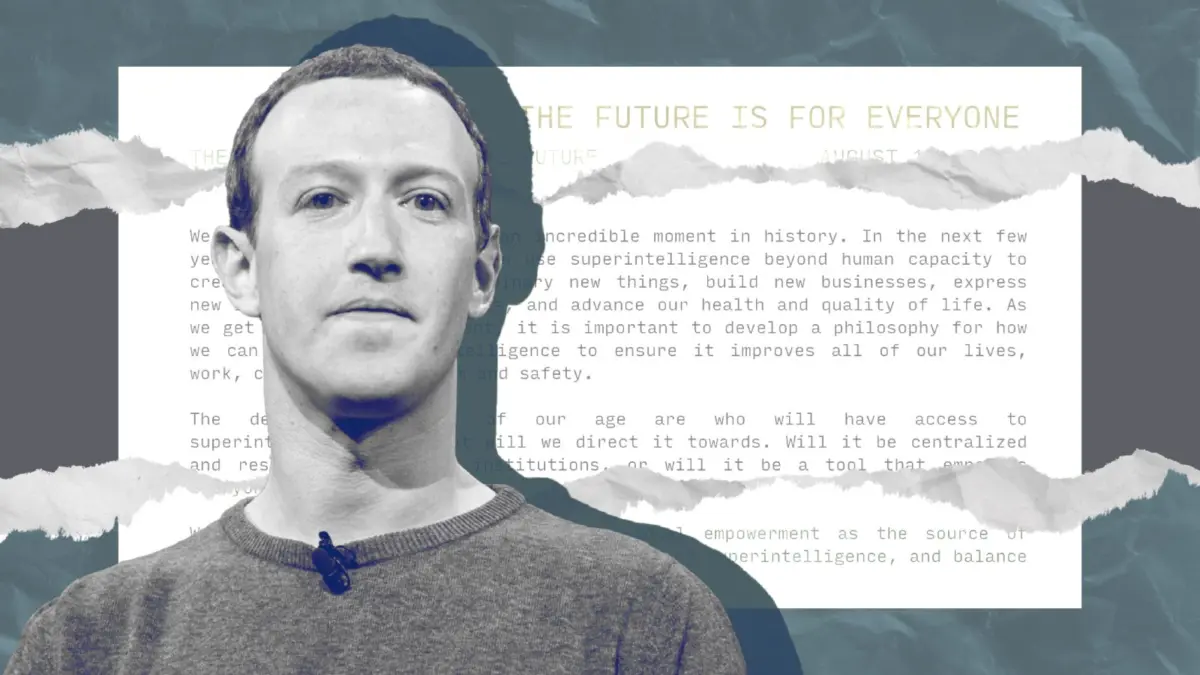
- August 10, The Manifesto Release: Zuckerberg publishes "The Future for Everyone," advocating for the radical decentralization of AI tools while simultaneously detailing Meta’s massive capital expenditures in data infrastructure, energy partnerships, and hardware deployment.
- Post-Publication Global Pushback (August–Present): International researchers, policy architects, and human rights advocates immediately counter the manifesto’s narrative. Concerns are raised regarding the physical strain of data centers on fragile local electrical grids, the systemic exclusion of low-resource languages, and the underlying geopolitical alignments of U.S. multinational technology firms.
Supporting Context & Metrics: Infrastructure Realities vs. Corporate Claims
The divergence between Meta’s economic projections and local empirical realities is perhaps most acutely visible in the infrastructure sector. Data centers—the physical lifeblood of generative AI—demand unprecedented volumes of computational power, water, and electricity.
The Energy Crisis and Grid Instability
Zuckerberg’s vision assumes a seamless global capacity to absorb and operate massive AI computational nodes. However, regional data center deployments in emerging economies have frequently collided with critical infrastructure bottlenecks:
- Kenya’s Geothermal Suspension: High-profile plans for a Microsoft- and G42-backed geothermal-powered data center in Kenya encountered severe delays, underscored by underlying constraints in national power grid stability.
- Sub-Saharan Capacity Deficits: Upcoming industrial initiatives, such as Cassava AI’s Nvidia-powered "AI factories," threaten to exacerbate ongoing electricity rationing and grid reliability concerns in economic hubs like South Africa and Nigeria.
The Economic Mismatch of Data Centers
According to Chinasa T. Okolo, founder and scientific director of Technecultura and the inaugural policy lead of Black in AI, Meta has "grossly overstated the economic benefits of its data centers." While marketing campaigns often target rural towns—frequently drawing parallels to historical investments in manufacturing or mining sectors—the long-term economic dividends rarely materialize for local populations:
- Employment Discrepancies: The labor boom associated with data centers is overwhelmingly front-loaded into the temporary construction phase. Once operational, facilities employ a minimal fraction of permanent personnel.
- The Wage-Property Gap: While empirical studies (such as research from the Brookings Institution) indicate a marginal upward pressure on local housing prices near data center sites, this effect fails to translate into elevated wages for the surrounding workforce.
- Environmental Externalities: In regions with relaxed regulatory enforcement or limited state capacity for compliance monitoring, the environmental and public health tolls of heavy industrial cooling systems and carbon footprints fall disproportionately on vulnerable local communities.
Official Statements & Expert Analyses
The international panel assembled by Rest of World dissected the manifesto across several thematic dimensions, highlighting profound gaps in Meta’s strategic foresight.
1. The Rhetoric of Inclusion vs. Marginalized Realities
Zuckerberg’s manifesto relies heavily on the inclusive pronoun "everyone," yet independent analysts point to structural exclusions embedded within the architecture of modern AI:
"Zuckerberg’s definition of ‘everyone’ largely excludes people at the margins of the digital ecosystem: speakers of low-resource and tribal languages, shared-device households, communities with intermittent connectivity, and populations for whom digital infrastructure remains uneven."
— Sagar Vishnoi, Director and Co-Founder of Future Shift Labs
Vishnoi argues that true educational and economic empowerment requires moving far beyond the deployment of larger models. It demands intentional investments in open-language infrastructure, consent-driven datasets, and community-led digitization programs.
Echoing this sentiment, Mark Mulobi, a products and practices associate at the Digital Impact Alliance, emphasizes the "last-mile" barriers that define daily life in Kenya and across broader Africa:
"Not everyone is online, digitally proficient, or able to engage with AI in English… Without deliberate investment in African languages and local knowledge systems, AI risks widening existing digital divides rather than becoming the empowering, inclusive technology that this vision aspires for it to be."
2. Geopolitical Alignment and the Corporate State
Analyzing the dual messaging of the manifesto, Juan Ortiz-Freuler, co-founder of the Non-Aligned Technologies Movement, points to an inherent contradiction in Meta’s global posture:
"While the first sections of the document target the global community—and regulators in places like Brazil, India, Turkey, and Nigeria—with a message of transparency, horizontality, and willingness to cooperate broadly, the latter sections are directed to U.S. regulators and power brokers who expect Meta to be a vector of U.S. power."
Ortiz-Freuler characterizes Meta not merely as a neutral cloud infrastructure provider, but as an intelligence apparatus. By leveraging human interaction to map complex social networks and symbolic relationships, the corporation optimizes its algorithmic architectures to serve corporate profit motives while simultaneously aligning with U.S. geopolitical objectives and "America First" agendas.
3. Historical Precedent and Institutional Trust
Dr. Abeba Birhane, founder of Trinity College Dublin’s AI Accountability Lab, draws a direct line between Meta’s current AI manifesto and its past digital expansion strategies in the Global South:
"Zuckerberg’s claim of ‘AI for everyone’ is nothing new. Decades ago, when Facebook overtook much of the African continent, Zuckerberg’s motto was something like, ‘connecting the rural and unconnected women across the continent.’ Now, with a full grip on the continent’s digital infrastructure, Facebook/Meta has amassed populations’ data, monopolized the digital sphere, and controls the information ecosystem, with no observable benefit to the actual rural women it once boasted it would benefit."
Birhane further dismisses the credibility of Meta’s altruistic narrative, citing a sustained corporate pattern of labor exploitation, data extraction, the suppression of internal dissent, and the minimization of product-related harms directed at vulnerable demographics, including minors.
4. The Multidimensional Architecture of Trust
Closing the loop on governance and deployment, Priya Vora, CEO of the Digital Impact Alliance, argues that technology cannot succeed on participation alone:
"Technology must be grounded in four guiding principles: participation, agency, choice, and trust. The letter speaks to participation, but meaningful participation requires people to have agency and choice—and to trust the systems they are being asked to use."
Vora asserts that trust cannot be achieved through corporate self-certification. It requires proactive co-design with high-accessibility user groups, rigorous data transparency, and accessible legal recourse when algorithmic systems fail.
Future Outlook: Navigating the Divide
As artificial intelligence systems approach theoretical thresholds of superintelligence, the ideological battle over who controls, shapes, and benefits from this technology will only intensify. Meta’s "The Future for Everyone" manifesto serves as a foundational text for Silicon Valley’s techno-optimist movement, sketching a landscape of unbounded human capability enabled by open distribution.
However, the warnings issued by Okolo, Vishnoi, Mulobi, Ortiz-Freuler, Birhane, and Vora expose a fragile foundation beneath this grand architecture. If major technology conglomerates continue to pursue scaling strategies that ignore regional energy constraints, linguistic diversity, local economic realities, and foundational user trust, the realization of superintelligence may deliver precisely the opposite of its promise.
Rather than acting as a great global equalizer, unchecked AI expansion threatens to entrench a new digital colonialism—one where the algorithmic tools of the future are built upon the strained infrastructure, uncompensated labor, and extracted data of the developing world, while the governing power remains concentrated firmly within the boardrooms of Silicon Valley. To avert this outcome, international regulators, civil society organizations, and local developers must demand a fundamental restructuring of how AI infrastructure is conceived, financed, and deployed across the globe.