

Executive Overview
Network infrastructure relies on a web of trust assumptions that have quietly persisted for decades. Chief among them is the core tenet of Network Address Translation (NAT): devices operating behind a shared gateway or firewall are generally assumed to be friendly, or at the very least incapable of maliciously manipulating one another’s connection-tracking states.
A groundbreaking new attack class called NatJack, disclosed independently by security researcher Malcolm Stagg of SODIUM-24, shatters this foundational assumption. Unveiled at the Black Hat USA 2026 briefings, NatJack reveals that an attacker with privileged access to a single host behind a shared NAT gateway can systematically compromise surrounding systems. By manipulating connection states, an adversary can hijack active Transmission Control Protocol (TCP) sessions, spoof Domain Name System (DNS) responses, expose externally mapped ports, and launch resource-exhaustion denial-of-service (DoS) attacks that entirely paralyze the NAT table.
Extensive testing across dozens of real-world network infrastructure products—as well as widely deployed operating systems like Windows and Linux—proves that NatJack is not an isolated bug, but a systemic class of architectural vulnerabilities. Two prominent implementation-specific flaws have already been assigned Common Vulnerabilities and Exposures (CVE) identifiers: CVE-2026-56181 (CVSS score: 8.3), affecting the Windows NAT engine used by Hyper-V, and CVE-2026-63913 (CVSS score: 8.2), impacting the Linux Netfilter conntrack subsystem.
Because NatJack exploits the fundamental design logic of how NAT infrastructure tracks network flows, there is no single, all-encompassing software patch. While kernel developers and operating system vendors have rushed to issue updates to address specific logic errors, security experts emphasize that mitigating the broader attack vector requires fundamental shifts in internal network architecture, including strict workload segmentation, end-to-end traffic encryption, and the deployment of IP Source Guard.
Detailed Chronology & Technical Breakdown
The genesis of NatJack lies in a critical design oversight present in numerous software and hardware NAT implementations. Historically, network architects assumed that internal adversaries could only launch attacks constrained by standard local area network (LAN) boundaries, such as ARP poisoning or standard man-in-the-middle (MitM) techniques. NAT gateways were designed to translate private IP addresses to public ones efficiently, maintaining a state table of active outgoing connections to route incoming responses back to the correct internal client.

However, Stagg’s research—conducted under the project name SODIUM-24—demonstrates that connection-tracking (conntrack) tables can be manipulated from behind the NAT boundary. By sending specially crafted network packets, an unprivileged or privileged attacker on a local network can alter how the gateway interprets and manages connection states for other hosts sharing that same NAT infrastructure.
The Four Primary Attack Vectors
The NatJack research outlines four distinct, highly effective exploitation paths:
- Active TCP Session Hijacking:
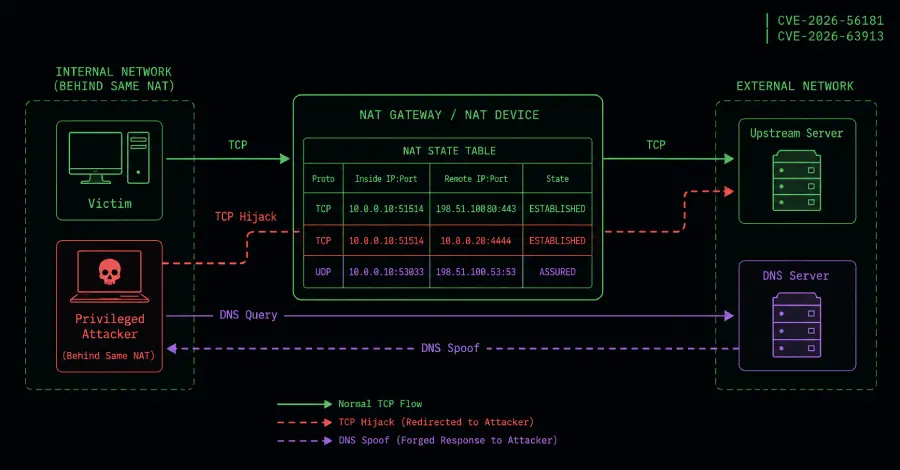
By intercepting or replacing active NAT mappings, an attacker can seamlessly redirect traffic belonging to an established TCP session between a victim machine and an external server. This allows data to be silently intercepted or injected mid-stream without triggering immediate connection teardowns. - DNS Response Interception and Spoofing:
An attacker can manipulate the state of outbound DNS requests originating from a peer machine. By racing the legitimate DNS response or altering the mapping state, the actual DNS reply from the upstream resolver is intercepted by the attacker, who then forwards a malicious, forged response back to the victim. This enables seamless redirection to phishing or malware-hosting infrastructure. - External Port Exposure:
NatJack techniques allow malicious actors to probe and expose externally mapped ports belonging to other devices behind the same gateway, effectively bypassing internal firewall boundaries and mapping rules designed to isolate workloads. - NAT Table Exhaustion (Denial of Service):
By flooding the gateway with spoofed data flows and malformed handshake packets, an attacker can artificially inflate the number of entries in the conntrack table. This exhausts available resources, preventing legitimate clients on the network from establishing new connections or accessing critical network services.
Deep Dive: Linux Netfilter Conntrack (CVE-2026-63913)
On Linux systems, the core vulnerability centers around the Netfilter conntrack module, which tracks the state of all network connections passing through the kernel’s firewall.
According to the official kernel.org CNA record for CVE-2026-63913, the flaw is triggered when an attacker sends a crafted SYN packet followed immediately by a reset (RST) packet containing an invalid sequence number. Because the netfilter conntrack logic fails to properly validate the direction and sequence of the incoming reset packet, it prematurely forces an active NAT entry into a closed state.
This premature closure corrupts the stateful tracking table, allowing the attacker to hijack the slot or cause downstream spoofing conditions. To combat this, core developers have pushed fixes across multiple stable kernel series, including versions 5.10.259, 5.15.210, 6.1.176, 6.6.143, 6.12.93, 6.18.35, 7.0.12, and 7.1. However, Stagg notes that while these kernel patches resolve the specific code flaw, they only partially mitigate the broader downstream-spoofing techniques by marginally increasing attack complexity rather than eliminating the root design assumption.
Deep Dive: Windows NAT and Hyper-V (CVE-2026-56181)
In the Windows ecosystem, Microsoft’s vulnerability advisory for CVE-2026-56181 identifies an origin-validation error within the Windows NAT driver heavily utilized by Hyper-V virtual switches and container networking environments. This flaw allows an attacker situated on an adjacent network or shared virtual switch to spoof packets and manipulate translation tables.

The vulnerability impacts several core operating system releases:
- Windows 11 (Version 24H2): Fixed in builds prior to
26100.8875 - Windows 11 (Version 25H2): Fixed in builds prior to
26200.8875 - Windows 26H1: Fixed in builds prior to
28000.2525 - Windows Server 2025: Fixed in builds prior to
26100.33158
Organizations utilizing dense virtualization environments or containerized microservices running on shared Hyper-V internal switches are at heightened risk if unprivileged users or compromised guest containers share the same NAT virtual interface.
Supporting Context & Historical Evolution
NatJack does not exist in a vacuum; it represents the latest evolution in a growing body of academic and independent research highlighting the structural fragility of network state-tracking mechanisms.
In June 2024, security analysts uncovered the SnailLoad attack, which exploited network delay variations and NAT state characteristics to exfiltrate data from air-gapped or restricted systems. Furthermore, a landmark study presented at the NDSS Symposium 2024 ("Exploiting Sequence Number Leakage: TCP Hijacking in NAT-Enabled Wi-Fi Networks") demonstrated similar TCP session hijacking techniques by manipulating NAT mappings. That study evaluated 67 commercially available routers and found a staggering 52 to be susceptible, ultimately generating ten distinct CVEs.
+-----------------------------------------------------------------+
|                       THE NATJACK THREAT VECTOR                 |
+-----------------------------------------------------------------+
|                                                                 |
|   [ Attacker VM / Host ]                                        |
|           |                                                     |
|           | (Sends crafted SYN/RST packets)                     |
|           v                                                     |
|   [ Shared NAT Gateway / Netfilter Conntrack / Windows NAT ]    |
|           |                                                     |
|           +-------------------------+                           |
|           | (Manipulates state table|                           |
|           |  & connection mappings) |                           |
|           v                         v                           |
|   [ Victim Host A ]           [ Victim Host B ]                 |
|   (TCP Session Hijacked)     (DNS Responses Spoofed)            |
|                                                                 |
+-----------------------------------------------------------------+
Synack and other security auditing firms confirmed that Malcolm Stagg tested his proof-of-concept exploits against dozens of real-world enterprise network infrastructure devices from various hardware vendors. Although the official natjack.io project portal does not currently publish an exhaustive, product-by-product vulnerability matrix, investigative reporting by The Hacker News confirmed that there was no public evidence of NatJack techniques being actively exploited in the wild as of August 7, 2026.
Official Statements & Industry Response
The cybersecurity community has responded to the disclosure of NatJack with a mixture of urgency and architectural reassessment. Because the attack vector targets the conceptual design of stateful packet inspection rather than a simple buffer overflow or memory corruption bug, vendors cannot rely on traditional patching methodologies alone.

In statements accompanying the Black Hat briefings, Malcolm Stagg emphasized that modern network security tooling often suffers from a false sense of security regarding internal network zones. "When we place multiple workloads behind a NAT interface—whether in a corporate office sharing a Wi-Fi router, a cloud provider hosting multi-tenant virtual machines, or a local developer workstation running containers—we implicitly trust that the underlying stack isolates those streams," Stagg noted. "NatJack proves that the state tables themselves can become weapons when manipulated from within."
Major enterprise security vendors have echoed these concerns. Corelight and ThreatLocker have both highlighted the necessity of deep network visibility and internal traffic inspection. Because NatJack attacks occur beneath the application layer within the kernel’s packet-handling routines, traditional perimeter firewalls and endpoint detection and response (EDR) agents may fail to detect the initial manipulation of conntrack states unless deep packet inspection (DPI) and network telemetry are actively monitored.
Future Outlook & Mitigation Strategies
As organizations digest the implications of NatJack, security leadership must move beyond patch management and re-evaluate their defense-in-depth strategies. Relying solely on NAT for isolation in multi-tenant or mixed-trust environments is no longer viable.
Recommended Defense-in-Depth Measures
- Strict Workload Segregation:
Isolate untrusted workloads, guest virtual machines, and containerized applications onto completely separate virtual local area networks (VLANs) or dedicated routing instances rather than sharing a common NAT pool with critical enterprise assets. - End-to-End Encryption:
Enforce Transport Layer Security (TLS) and IPsec even within internal enterprise networks. Encrypting traffic payloads mitigates the risk of successful data injection or session tampering, even if an attacker successfully manipulates underlying TCP mapping states. - Deployment of IP Source Guard:
Implement IP Source Guard on enterprise switches and network gateways to prevent malicious hosts from spoofing IP addresses and injecting unauthorized packet flows into the routing infrastructure. - Immediate Patch Deployment:
Apply the latest operating system and kernel updates—specifically targeting Linux kernel releases containing fixes for CVE-2026-63913 and Microsoft security updates addressing CVE-2026-56181—to raise the technical complexity required for exploitation.
Ultimately, NatJack serves as a stark reminder that foundational internet protocols and operating system subsystems must continually evolve to meet modern threat models. As network architectures become increasingly dense and virtualized, eliminating implicit trust assumptions within local infrastructure will remain a paramount challenge for security professionals worldwide.