
Executive Overview
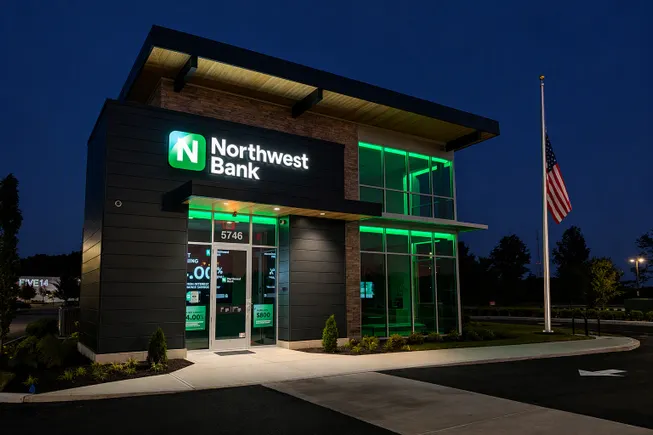
Over the past three years, Northwest Bank—a 130-year-old financial institution historically tethered to its identity as a traditional thrift—has executed a sweeping transformation. At the core of this overhaul is a deliberate, systematic replacement of its entire C-suite leadership team. Led by CEO Louis Torchio, who took the helm in 2022, the bank has swapped out all 13 members of its direct-report leadership roster, recruiting seasoned veterans from larger, highly complex financial institutions.
This leadership migration has catalyzed a comprehensive balance sheet restructuring, a rapid pivot from a residential mortgage focus toward a diversified commercial banking profile, and the successful completion of value-additive mergers and acquisitions. Today, Northwest stands as a formidable $17 billion-asset regional bank. Bolstered by national specialty verticals, targeted geographic expansion in dynamic markets like Columbus and Indianapolis, and a lean, agile executive culture, Northwest offers a masterclass in how regional lenders can leverage big-bank talent to punch above their weight class.
Detailed Chronology: The Three-Year C-Suite Migration
The architectural blueprint of Northwest Bank’s transformation began taking shape immediately after Louis Torchio assumed the chief executive position in 2022. Recognizing that legacy institutions cannot reform themselves using the same mindsets that built them, Torchio embarked on an aggressive talent acquisition campaign. The mandate was clear: recruit top-tier executives from "larger, more complex institutions" who possessed both the strategic acumen and the operational capacity to scale a regional lender.
"The goal was to be able to articulate this transformation vision and then recruit people who have been there, done that," Torchio explained in a recent interview. To execute a complex corporate revamp, he noted, leadership must possess firsthand experience at scale; otherwise, the organization risks learning painful, expensive lessons on the fly.
Over a 36-month period, every single direct report under Torchio was replaced—a total of 13 executive positions. This systematic infusion of big-bank DNA brought in leaders from some of the most prominent names in American finance:
- Chief Financial Officer (CFO): Doug Schosser joined the bank, bringing elite financial strategy experience honed at KeyBank.
- Chief Risk Officer (CRO): Gregory Betchkal was brought aboard, leveraging his extensive risk management background from stints at Citigroup and KeyBank.
- Chief Marketing and Communications Officer: Devin Teles-Cygnar arrived with deep institutional knowledge acquired at PNC Financial Services.
- Chief Consumer Banking and Strategy Officer: Urich Bowers also joined from PNC, providing robust consumer-facing strategy and execution expertise.
- Chief Information Officer (CIO): The final linchpin in the executive restructuring fell into place in May with the hiring of Chad Ballard from Wells Fargo. Ballard was immediately tasked with auditing and optimizing the bank’s technology infrastructure and IT spending to support future scalable growth.
According to executive leadership, this influx of fresh talent created a powerful cultural feedback loop. As more seasoned executives joined the ranks, a collaborative environment took root. According to CFO Doug Schosser, the dynamic among the newly minted leadership team was defined by continuous, cross-functional experimentation: "The more new C-suite leaders that joined, the more we fed off each other and were like, ‘Hey, let’s try this. Let’s think about that.’"
Supporting Context & Metrics: Pivoting the Balance Sheet and Expanding Footprint
The strategic rationale behind Northwest’s executive migration was not merely cosmetic; it was fundamentally tied to a radical reshaping of the bank’s asset and revenue generation models. Historically defined by a heavy reliance on consumer mortgages and retail deposits, the 130-year-old thrift recognized that organic geographic expansion within its traditional, hyper-competitive footprint would take a decade to yield meaningful results.
To bypass this bottleneck, Northwest executed a two-pronged strategic pivot in 2023: establishing national specialty commercial lending verticals and expanding aggressively into high-growth urban markets.
Building National Specialty Verticals
Rather than fighting for market share in overbanked local consumer markets, Northwest chose to deploy specialized commercial teams nationally. The bank successfully launched verticals spanning Small Business Administration (SBA) lending, equipment finance, sports finance, sponsor finance, and franchise finance.
These national specialty verticals have rapidly matured into significant revenue drivers, accounting for approximately one-fifth of the bank’s total commercial lending business. By the close of 2025, Northwest’s commercial loans within these specialized national segments reached approximately $1.3 billion.
Accelerating Commercial and Industrial (C&I) Growth
The results of this strategic reallocation are clearly visible in the bank’s recent financial disclosures. During the second quarter, Northwest reported a staggering 32% year-over-year increase in commercial and industrial (C&I) loans, pushing that portfolio to $2.8 billion. Average loans expanded by $10 million over the prior quarter to reach $13.1 billion, underpinned by robust C&I momentum. Concurrently, the institution maintained a stable deposit base of approximately $14.1 billion, while actively scaling its commercial real estate (CRE) portfolio—which stood at $3.1 billion in the second quarter—within its primary physical footprint.
M&A as a Transformative Lever
Organic growth has been aggressively complemented by inorganic expansion. Last year, Northwest finalized a landmark $270.4 million acquisition of Williamsport, Pennsylvania-based Penns Woods Bancorp, absorbing $2.3 billion in assets and meaningfully altering its financial trajectory.
According to CFO Doug Schosser, the Penns Woods transaction was the first M&A deal executed by the new leadership team. Notably, the bank achieved tangible book value accretion much faster than initially projected. This milestone proved that Northwest could effectively deploy mergers and acquisitions as a core, transformative lever in its broader growth strategy.
Official Statements: The Human Element of Regional Banking Agility
While large national banks offer vast resources, they frequently suffer from corporate bloat, rigid hierarchies, and institutional inertia. Northwest’s leadership team emphasizes that the bank’s mid-sized footprint—combined with its newly acquired executive talent—creates a unique competitive advantage centered on speed and individual impact.
CEO Louis Torchio noted that many high-performing executives at massive financial institutions find themselves pigeonholed. Trapped within bureaucratic silos, these leaders often feel their broader strategic views are stifled. Northwest offered them a rare proposition: the chance to step into a dynamic environment where their decisions directly shape the trajectory of a growing regional institution.
CFO Doug Schosser contrasted the nimbleness of Northwest’s flat, collaborative structure with the cumbersome bureaucracy of his prior corporate homes. At major lenders, executing a cross-departmental initiative can require navigating layers of red tape and committee approvals. At Northwest, Schosser observed: "The 10 people that you have to get something done with are sitting right next to you on the same floor, and you can move with rapid speed."
This operational velocity allows the bank to capitalize on market opportunities long before slower-moving mega-banks can mobilize their internal committees. It is this combination of big-bank pedigree and small-bank agility that has allowed Northwest to punch well above its weight class.
Future Outlook: Navigating M&A Patience and Long-Term Scale
Looking toward the horizon, Northwest Bank’s leadership team remains disciplined yet ambitious. The stellar performance metrics reported in recent quarters—including $54 million in second-quarter profit, a robust 14.9% return on tangible common equity (ROTCE), and an efficient 57.6% efficiency ratio—demonstrate that the bank’s transformation is delivering bottom-line results.
However, sustaining this momentum requires careful calibration, particularly regarding future mergers and acquisitions. While Torchio and his team maintain a strong appetite for additional bank acquisitions—ideally targeting the attractive, growing markets of Ohio and Indiana—market realities require a measured approach.
"There just aren’t a lot of targets," Torchio acknowledged, noting that executive leadership conducts continuous quarterly outreach to monitor potential opportunities. Rather than forcing subpar deals, Northwest is committed to strategic patience. "We have to be patient," Torchio emphasized. "You never know what’s going to come available when, and so we keep at it and we keep our options open."
With its C-suite fully fortified by big-bank veterans, its technology infrastructure under active optimization by CIO Chad Ballard, and its balance sheet successfully reoriented toward high-yield commercial verticals, Northwest Bank has permanently shed its identity as a sleepy 130-year-old thrift. As it eyes future consolidation and continued organic market penetration in urban hubs like Columbus and Indianapolis, the institution stands well-positioned to write the next chapter of regional banking success.